Choosing a packaging machine is one of the most strategic decisions for any seafood processor. Unlike many food categories, seafood is highly perishable and sensitive to microbial growth, oxidation, moisture loss, and temperature fluctuations. Packaging therefore plays a critical role in preserving product quality, extending shelf life, and ensuring food safety throughout distribution.
Today’s seafood manufacturers must also respond to changing market expectations. Retailers demand longer shelf life, consumers expect attractive packaging and consistent quality, and food safety regulations continue to become more stringent. At the same time, processors are under pressure to increase productivity, reduce labor dependency, minimize packaging waste, and improve operational efficiency.
For these reasons, selecting a packaging machine should never be based solely on purchase price or advertised production speed. The right machine must fit the product, production process, packaging method, and long-term business strategy.
This guide explains the key engineering, operational, and commercial factors that should be evaluated before investing in seafood packaging equipment. Whether you package fresh fish, salmon, shrimp, shellfish, frozen seafood, or value-added seafood meals, following a structured selection process will help maximize productivity while reducing long-term operating costs.
Why Packaging Equipment Is Critical for Seafood Processing
Seafood continues to deteriorate after harvesting because of enzymatic activity, microbial growth, and oxidation. Proper refrigeration slows these processes, but packaging largely determines how effectively freshness can be maintained during storage and transportation.
A properly selected packaging system provides several important benefits:
- Extends refrigerated shelf life
- Maintains product appearance
- Protects against contamination
- Reduces oxidation
- Improves seal reliability
- Minimizes product waste
- Supports food safety compliance
- Increases production efficiency
Conversely, poor equipment selection may lead to weak seals, excessive residual oxygen, packaging failures, unnecessary downtime, and increased operating costs.
Because packaging directly influences both product quality and profitability, equipment selection should be approached as a long-term investment rather than a simple purchasing decision.
Start With Production Volume and Capacity Planning
The first step in selecting any seafood packaging machine is defining your production requirements.
Many companies begin by comparing machine specifications, but experienced packaging engineers first calculate the required production capacity. This ensures that equipment is selected based on operational needs rather than marketing claims.
Before evaluating machine models, answer the following questions:
- How many packs are produced per shift?
- How many operating hours are available each day?
- How many product changeovers occur each week?
- Is production seasonal or consistent throughout the year?
- Are new products planned within the next three to five years?
- Will export sales increase production demand?
These answers establish the production profile that determines machine size, automation level, tooling configuration, and vacuum capacity.
Calculate Actual Production Requirements
Consider the following example.
A seafood processor packages:
- 7,200 trays per day
- One 8-hour shift
Required output:
900 finished packs per hour
However, this calculation assumes uninterrupted production.
In reality, every production line experiences scheduled interruptions, including:
- Film roll replacement
- Tray replenishment
- Cleaning and sanitation
- Product changeovers
- Preventive maintenance
- Quality inspections
- Operator breaks
For this reason, packaging engineers generally recommend selecting equipment with 20–30% additional capacity beyond current production requirements. This reserve improves flexibility, accommodates seasonal demand, and reduces the risk of future bottlenecks.
Measure Productivity Using Packs per Hour
One of the most common purchasing mistakes is comparing machines based only on cycles per minute.
Cycle speed alone does not represent actual production capacity. True productivity depends on several variables, including:
- Number of trays sealed per cycle
- Tool configuration
- Product loading time
- Vacuum duration
- Gas flushing time (for MAP)
- Film indexing speed
- Automation level
Two tray sealers may both operate at 10 cycles per minute, yet one can produce significantly more finished packages because it seals more trays during each cycle.
For purchasing decisions, finished packs per hour is the most meaningful performance indicator.
Select Equipment That Supports Future Growth
Packaging machinery is typically expected to operate for many years. Choosing equipment based only on current production often leads to expensive upgrades when demand increases.
As a general guideline:
| Production Volume | Recommended Equipment |
|---|---|
| Up to 500 packs/hour | Semi-automatic tray sealer |
| 500–1,500 packs/hour | Automatic tray sealer |
| Above 1,500 packs/hour | Fully automatic inline tray sealer |
| High-volume export production | Integrated automated packaging line |
Selecting a machine with reasonable expansion capacity allows manufacturers to increase production without replacing their entire packaging system.
Consider Overall Equipment Effectiveness (OEE)
Production capacity alone does not determine packaging efficiency.
Many manufacturers now evaluate packaging equipment using Overall Equipment Effectiveness (OEE), a performance metric that combines:
- Availability – How often the machine is running when scheduled.
- Performance – How closely the machine operates to its designed speed.
- Quality – The percentage of packages produced without defects.
A machine with a slightly lower rated speed but higher OEE may deliver greater daily output than a faster machine that experiences frequent downtime or quality issues.
When comparing equipment, ask suppliers for real production data rather than theoretical maximum capacities.
Expert Recommendation
Before approving a machine purchase, perform a Factory Acceptance Test (FAT) using your own seafood products, trays, and packaging films. Evaluate seal integrity, package appearance, vacuum consistency, gas-flushing performance (for MAP applications), and production repeatability. Testing under actual operating conditions is the most reliable way to confirm that the equipment will meet your performance expectations after installation.
Match the Packaging Machine to Your Product and Packaging Method
After defining your production capacity, the next step is selecting equipment that matches the characteristics of your seafood products. This is one of the most critical stages in the buying process because packaging performance depends on the interaction between the product, packaging material, sealing technology, and machine capabilities.
A machine that performs exceptionally well for fresh salmon may not be the best solution for frozen shrimp or live shellfish. Product dimensions, moisture content, fat levels, storage conditions, and shelf-life requirements all influence the optimal packaging method.
For this reason, professional equipment selection should always begin with the product rather than the machine specification.
Choose the Right Machine for Your Seafood Product
Different seafood products require different packaging technologies.
| Product Type | Recommended Packaging Method | Recommended Machine |
|---|---|---|
| Fresh fish fillets | MAP Tray Sealing | Automatic Tray Sealer |
| Salmon portions | MAP | Automatic Tray Sealer |
| Whole fish | Vacuum Skin or MAP | Deep-tray Tray Sealer |
| Shrimp & prawns | MAP or Vacuum | Tray Sealer |
| Shellfish | MAP | Automatic Tray Sealer |
| Frozen seafood | Vacuum or Top Seal | Tray Sealer / Vacuum Chamber |
| Smoked seafood | Vacuum | Vacuum Chamber |
Selecting equipment according to product characteristics helps improve package consistency, shelf life, and production efficiency.
Packaging Fresh Fish
Fresh fish deteriorates rapidly because of microbial activity and enzymatic reactions. To maintain quality, the packaging process must consistently control oxygen exposure and seal integrity.
A suitable packaging machine should provide:
- Stable sealing temperature
- Uniform sealing pressure
- Accurate dwell time
- Reliable vacuum performance
- Consistent tray positioning
For chilled retail products, Modified Atmosphere Packaging (MAP) is often preferred because it extends refrigerated shelf life while maintaining an attractive appearance.
Packaging Salmon
Salmon contains a high concentration of unsaturated fatty acids, making it particularly vulnerable to oxidation.
Packaging systems should therefore support:
- High-barrier films
- Accurate MAP gas flushing
- Low residual oxygen
- Reliable seal quality
Processors supplying premium retail markets also commonly specify anti-fog films to improve product visibility during refrigerated display.
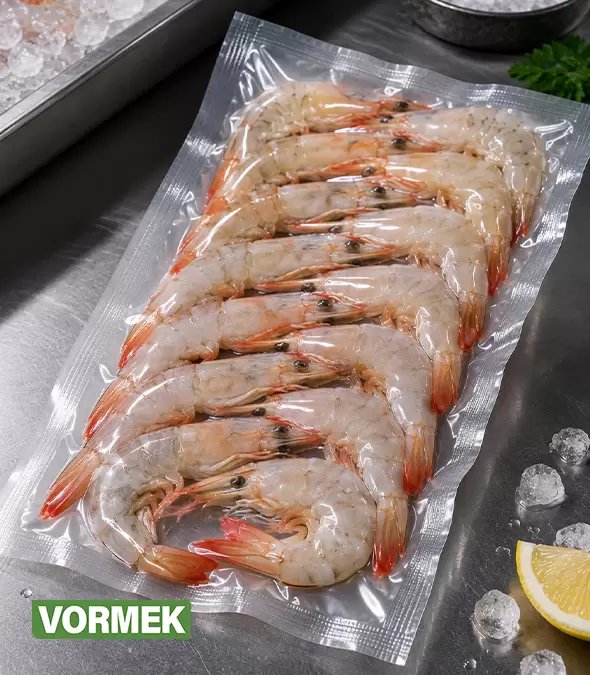
Packaging Shrimp and Shellfish
Shrimp and shellfish present additional challenges due to:
- High surface moisture
- Irregular shapes
- Variable fill heights
- Ice glazing
- Shell fragments
Machines should therefore maintain consistent sealing performance even when moisture is present around the tray flange.
Stable film tracking and accurate tray alignment are also essential for minimizing rejected packages.
Select the Right Packaging Technology
Choosing the correct packaging technology is just as important as selecting the machine itself.
The most common technologies include:
Modified Atmosphere Packaging (MAP)
MAP replaces atmospheric air with a controlled gas mixture before sealing.
Typical advantages include:
- Extended refrigerated shelf life
- Reduced microbial growth
- Improved color stability
- Better retail presentation
- Reduced package collapse
MAP is commonly used for:
- Fresh fish
- Salmon
- Shrimp
- Premium seafood products
Vacuum Packaging
Vacuum packaging removes air before sealing.
Its primary advantages include:
- Reduced oxygen exposure
- Compact package dimensions
- Excellent freezer performance
- Improved transport stability
Vacuum packaging is particularly suitable for:
- Frozen seafood
- Smoked fish
- Foodservice products
- Export applications
Vacuum Skin Packaging (VSP)
For premium seafood products, Vacuum Skin Packaging provides superior product presentation by tightly conforming the film to the product.
Benefits include:
- Premium shelf appearance
- Reduced product movement
- Improved drip retention
- Excellent product protection
- Extended shelf life
Although VSP generally requires specialized tooling and compatible films, it has become increasingly popular for high-value seafood products sold through retail channels.
Choose Packaging Films Carefully
The packaging machine and packaging film should always be evaluated as a complete system.
Important film characteristics include:
- Oxygen barrier performance
- Moisture barrier performance
- Seal strength
- Seal initiation temperature
- Mechanical durability
- Transparency
- Anti-fog performance
- Printability
Using an unsuitable film may reduce package quality even when the packaging machine operates correctly.
High-Barrier Films
Most chilled seafood products require high-barrier multilayer films.
Typical structures include combinations of:
- Polyethylene (PE)
- Polypropylene (PP)
- Polyamide (PA)
- Ethylene Vinyl Alcohol (EVOH)
Each layer contributes different functional properties.
| Material | Primary Function |
|---|---|
| PE | Heat sealing and moisture resistance |
| PP | Mechanical strength |
| PA | Puncture resistance |
| EVOH | Oxygen barrier |
The sealing system should be capable of producing repeatable seals without compromising the barrier layer.
Understanding OTR and WVTR
When comparing packaging films, two technical specifications deserve particular attention.
Oxygen Transmission Rate (OTR)
OTR measures the amount of oxygen passing through the packaging material.
Lower OTR values generally provide:
- Better oxidation control
- Longer shelf life
- Improved freshness
- Better color stability
Water Vapor Transmission Rate (WVTR)
WVTR measures moisture transmission through the packaging material.
Proper moisture control helps prevent:
- Product dehydration
- Excess condensation
- Weight loss
- Texture changes
Balancing OTR and WVTR is essential for achieving the desired shelf-life performance.
Why Anti-Fog Films Matter
Temperature fluctuations during cold storage often produce condensation inside seafood packages.
Anti-fog films prevent water droplets from forming on the inner surface, improving product visibility throughout retail display.
Advantages include:
- Better shelf presentation
- Increased consumer confidence
- Enhanced product visibility
- Reduced perception of poor freshness
For premium seafood brands, anti-fog performance has become an important marketing advantage in addition to its technical benefits.
Validate the Complete Packaging System
The final purchasing decision should never rely solely on machine specifications.
Instead, validate the complete packaging system using your actual:
- Seafood products
- Packaging trays
- Packaging films
- Production parameters
A comprehensive Factory Acceptance Test (FAT) should include:
| Test | Purpose |
|---|---|
| Seal integrity | Detect leaks or weak seals |
| Vacuum performance | Verify repeatability |
| Gas-flushing accuracy | Confirm MAP performance |
| Residual oxygen measurement | Validate package quality |
| Film tracking | Reduce material waste |
| Package appearance | Assess retail quality |
| Cleaning evaluation | Verify hygienic design |
Testing under real production conditions provides objective evidence that the equipment can consistently meet your operational requirements.
Expert Recommendation
Do not choose a packaging machine before selecting your packaging concept. First define the desired shelf life, distribution conditions, retail presentation, packaging format, and food safety objectives. Then select a machine capable of delivering those performance requirements consistently. This approach reduces investment risk, improves packaging reliability, and ensures the equipment remains suitable as production volumes and market demands evolve.
Select the Right Automation Level
Once the packaging method has been defined, the next decision is choosing the appropriate level of automation. The right choice depends on production volume, labor availability, product variety, and future expansion plans—not simply on the size of your budget.
A machine should support your current production while allowing room for future growth without creating unnecessary operating costs.
Semi-Automatic vs. Fully Automatic Tray Sealers
Both machine types are widely used in seafood processing, but each serves a different production environment.
| Feature | Semi-Automatic | Fully Automatic |
|---|---|---|
| Production volume | Low to medium | Medium to high |
| Labor requirement | Higher | Lower |
| Initial investment | Lower | Higher |
| Production consistency | Good | Excellent |
| Product changeovers | Faster | Moderate |
| Expansion potential | Moderate | Excellent |
The correct choice should be based on production requirements rather than purchase price.
When to Choose a Semi-Automatic Machine
Semi-automatic tray sealers are suitable for companies that:
- Produce multiple product varieties
- Have frequent tray size changes
- Operate with moderate production volumes
- Require production flexibility
- Are entering new markets
Because loading and unloading are performed manually, these machines offer quick product changeovers while maintaining reliable sealing performance.
When to Choose a Fully Automatic Machine
Fully automatic systems are recommended when production requires:
- Continuous operation
- High daily output
- Consistent package quality
- Reduced labor dependency
- Integration with automated production lines
Automatic tray sealers can easily connect with equipment such as:
- Tray denesters
- Portioning systems
- Multihead weighers
- Checkweighers
- Metal detectors
- Labeling systems
- Case packers
This integration improves production flow while reducing manual handling.
Consider Tooling Flexibility
The tooling (mold set) determines which tray dimensions and package configurations can be produced.
Before purchasing a machine, evaluate:
- Maximum tray dimensions
- Maximum product height
- Number of cavities per cycle
- Ease of tooling replacement
- Future tooling availability
If your product portfolio is expected to expand, selecting equipment with easily interchangeable tooling can significantly reduce future investment costs.
Evaluate Vacuum and Gas-Flushing Performance
For MAP applications, the vacuum system is one of the most important machine components.
A properly designed system should provide:
- Stable vacuum levels
- Repeatable gas flushing
- Uniform package quality
- Short cycle times
Poor vacuum performance can increase residual oxygen, reduce shelf life, and create inconsistent package quality.
When comparing suppliers, request performance data from packaging trials using products similar to your own.
Hygienic Design Matters
Seafood processing environments require equipment that can be cleaned quickly and thoroughly.
Important hygienic design features include:
- Stainless steel construction
- Smooth welded surfaces
- Sloped panels for water drainage
- Easy access for sanitation
- Corrosion-resistant components
- Washdown-compatible design
Machines designed according to hygienic engineering principles reduce cleaning time and help maintain consistent food safety standards.
Calculate Total Cost of Ownership (TCO)
The purchase price represents only a portion of the overall investment.
A complete evaluation should also consider:
- Installation costs
- Energy consumption
- Packaging material waste
- Preventive maintenance
- Spare parts
- Production downtime
- Operator training
- Service costs
In many cases, a higher-quality machine delivers a lower lifetime operating cost because it reduces downtime and improves production efficiency.
Evaluate the Supplier, Not Just the Machine
Long-term performance depends not only on equipment quality but also on the supplier’s ability to provide technical support.
Before making a purchasing decision, consider the following questions:
| Evaluation Point | Why It Matters |
|---|---|
| Is operator training included? | Faster production start-up |
| Are spare parts readily available? | Reduced downtime |
| Is remote technical support available? | Faster troubleshooting |
| Can the machine be upgraded? | Supports future expansion |
| Is preventive maintenance offered? | Improves equipment reliability |
Choosing a knowledgeable supplier with strong after-sales support often provides greater long-term value than selecting the lowest-priced machine.
Expert Recommendation
The best seafood packaging machine is one that matches your production objectives, packaging requirements, and future growth plans. Prioritize validated performance, hygienic design, tooling flexibility, and reliable technical support over headline production speeds or initial purchase price. A well-matched system will improve operational efficiency, protect product quality, and provide a stronger return on investment throughout its service life.
Common Mistakes to Avoid When Choosing a Seafood Packaging Machine
Selecting the right packaging machine requires balancing technical performance, operational efficiency, and long-term business objectives. The following mistakes are among the most common—and often the most expensive.
1. Choosing Based Only on Purchase Price
A lower purchase price does not necessarily mean a lower operating cost. Consider the Total Cost of Ownership (TCO), including maintenance, spare parts, energy consumption, packaging waste, and downtime.
2. Ignoring Future Production Growth
Many processors purchase equipment that only meets today’s production needs. If production volume increases, the machine may quickly become a bottleneck. Choosing equipment with additional capacity and upgrade options helps protect your investment.
3. Using Unvalidated Packaging Materials
Even the best packaging machine cannot compensate for incompatible trays or films. Always validate the complete packaging system—including trays, films, and sealing parameters—before full-scale production.
4. Overlooking After-Sales Support
Packaging machines are long-term production assets. Before purchasing, evaluate the supplier’s technical support, spare parts availability, operator training, and preventive maintenance services.
Seafood Packaging Machine Selection Checklist
Use this checklist before making your final purchasing decision.
| Evaluation Area | Key Question |
|---|---|
| Production Capacity | Can the machine handle current and future demand? |
| Product Compatibility | Has it been tested with your seafood products? |
| Packaging Technology | Does it support Vacuum or MAP if required? |
| Film Compatibility | Is it compatible with your preferred packaging films? |
| Hygienic Design | Is the machine easy to clean and maintain? |
| Tooling Flexibility | Can different tray sizes be accommodated? |
| Automation Level | Does it match your production strategy? |
| After-Sales Service | Are spare parts and technical support readily available? |
| ROI | Will operational savings justify the investment? |
Frequently Asked Questions
What is the best packaging machine for seafood?
There is no universal solution. The ideal machine depends on product type, production volume, packaging method, and shelf-life requirements. Most fresh seafood processors benefit from automatic tray sealers with Modified Atmosphere Packaging (MAP), while frozen or smoked products are often better suited to vacuum packaging.
Should I choose MAP or vacuum packaging?
MAP is generally preferred for fresh chilled seafood because it helps extend shelf life while maintaining product appearance. Vacuum packaging is commonly used for frozen seafood, smoked fish, and products intended for long-distance transportation.
Why are high-barrier films important?
High-barrier films reduce oxygen and moisture transmission, helping preserve freshness, minimize oxidation, and extend shelf life. Selecting the correct film is just as important as selecting the packaging machine.
How can I verify machine performance before purchase?
Request a Factory Acceptance Test (FAT) using your own products, trays, and packaging films. This confirms sealing quality, packaging consistency, and overall machine performance under real production conditions.
Conclusion
Choosing the right seafood and fish packaging machine is a strategic investment that directly affects product quality, shelf life, production efficiency, and operating costs. Rather than focusing solely on machine specifications or purchase price, manufacturers should evaluate the complete packaging system, including product characteristics, packaging technology, automation level, hygienic design, and supplier support.
A structured selection process reduces investment risk, improves production reliability, and creates a packaging operation that can adapt to future growth. By validating equipment with real products and selecting a supplier capable of providing long-term technical support, seafood processors can achieve consistent package quality while maximizing return on investment.